Showing posts with label Feminism. Show all posts

Monday, July 29, 2013

Where The Ladies At? - The Lack of Women in Geek Media


"Being a geek is all about being honest about what you enjoy and not being afraid to demonstrate that affection. It means never having to play it cool about how much you like something. It's basically a license to proudly emote on a somewhat childish level rather than behave like a supposed adult. Being a geek is extremely liberating." - Simon Pegg

I am a geek. There is very little that makes me light up more than discussing The Hobbit, the latest episode of Doctor Who or Marvel's plans for any of the upcoming superhero movies with a fellow fan. Joining the geek community felt completely natural, I have met so many friends and have had so much fun at geek events. I truly can't overstate the importance of being a geek in my life, it has provided joy and comfort by helping me find a social network and by giving me stories to explore on my own.

But right now I'm going to do something that is extremely difficult for me: I am going to criticize the franchises I love. Because, as Anita Sarkeesian puts it so well in her video series Tropes vs. Women in Video Games (which everyone should watch), "It is both possible (and even necessary) to simultaneously enjoy media while also being critical of it's more problematic or pernicious aspects." The pictures at the beginning of this post are promotions for some of the most popular franchises in current geekdom: The Avengers, The Hobbit, Sherlock, Doctor Who and Star Trek: Into Darkness. What I find problematic about these movies and TV Shows is the lack of women in leading roles. According to the NPR Blog: Monkey See, last month 90% of the leading characters in movie theaters were men, and a fair chunk of that came from what are, unquestionably, geek movies (Iron Man 3, Man of Steel, etc.)

This is not to say that these franchises are devoid of strong women. In fact, I think one of the many things that draws me to Sci-Fi and Fantasy stories is that I find more strong female characters there than in other genres. Some folks might be upset at my mention of Doctor Who considering that the Doctor almost always travels with a woman, who is usually a strong and well written character. It's true that the Doctor's female companions are some of my favorite characters, they participate in the action, often committing heroic acts that are all their own, and occasionally they even get to save the Doctor. But it must be acknowledged that the Doctor is consistently the one running the show, and his companions are along for the ride. Readers may also take issue with the inclusion of The Avengers, which was written and directed by Joss Whedon, who is often praised (often by me) as the forerunner in feminist television and film. There was a lot to love about Black Widow in The Avengers (I actually wrote about it in some detail), she was a great improvement to Iron Man 2 and to past attempts at female superheroes (I'm looking at you Elektra). However the obvious must be stated, that she was the only female on the team and unlike her friends -- Thor, Captain America, the Hulk and Iron Man, she has yet to be given her own movie.


It is undeniable that despite the presence of strong females in some popular franchises, the vast majority of leading roles are filled by men. Some might wonder, "What's so wrong with that? So long as there are strong female characters somewhere? Does it really matter?" My simple answer is- yes. Yes, it is a problem. This year I attended my first Sci-Fi convention and I loved it, but it forced me to examine that lack of females represented in geek media and the sometimes hostile attitude toward females in the community. If you are a cosplayer, the options for female superheroes are startlingly low, even lower if you are uncomfortable in revealing or heavily sexualized clothing, and lower yet if you are a woman of color. I have found several blog posts highlighting the instances of harassment and body shaming that occurs at conventions and I don't think it's a stretch to think the lack of female driven narratives has something to do with this. Having so few females in film and television creates an illusion that geek culture is male space, and often makes women feel unwelcome. Yet there are still plenty of women and girls who identify as geeks, and I believe this is because the stories I've mentioned are good stories. You don't have to be a man to relate to the struggles and triumphs of The Doctor or Bilbo. I see reflections of myself and people I love in many of the male characters I've mentioned. But it begs the question: Shouldn't men be expected to do the same for women?

So what can be done to change this? I believe there is some progress being made, however slowly. There are steps being taken already, but I'm not sure how successful they have been...

It is becoming less common for a television show or movie to be released without at least one female character; but what we end up getting is a lot of franchises with exactly one woman meant to balance out several men. Soon, we will have the second installment of The Hobbit joining these ranks. Peter Jackson has inserted a female elf, Tauriel, into an all male story. Since I'm a huge fan of the books, I'm not sure how I will feel about Tauriel. On the one hand, I appreciate that there was some awareness that there were NO women in the original story and they felt at least one strong woman was necessary. They succeeded in inserting some girl power into The Fellowship of the Ring by expanding Arwen's role, and I enjoyed that change from the books. However, I had mixed feeling about the deviations from the book in An Unexpected Journey, I thought some slowed down the plot and weren't very well written. I fear that Tauriel is merely a bone being thrown at feminists; she'll fire a couple arrows and won't contribute to the story in an interesting or meaningful way. A major problem with there being so little female representation, is it puts a great deal of weight on the women we do see. If the lone woman is poorly written, it hits female viewers hard and often makes it more difficult to convince Hollywood to invest in strong female characters in the future. Clearly, we need more than one woman inserted into the stories dominated by men. 

There are also the attempts to gender-swap characters that are already beloved by fans. For example, there was Elementary, America's answer to BBC's Sherlock. But CBS decided to do something a little different - they turned John Watson into Joan Watson and cast Lucy Lui in the role. It was a courageous move to give such an iconic role to a woman (and a woman of color) but, if my anecdotal evidence has any truth, fans of the BBC's series and fans of original books had a hard time adjusting to the change. Although, I sorely desire more successful female characters, I don't think a smart solution is replacing the male characters who are already popular. I have similar concerns with the growing demands for a woman to play the Doctor on Doctor Who. For those of you who don't watch the show, The Doctor is an alien who doesn't die but regenerates, thus allowing for eleven (soon to be twelve) different actors to play the same character over the past fifty years. Peter Capaldi was just announced as the 12th Doctor and some have expressed anger that yet another white male was chosen. I certainly understand the disappointment and feel some of it myself. However, I don't think the show is ready for a female Doctor, because I don't trust the all male writing staff to be able to do it right. Since the show got its reboot in 2005 there have only been two serials written by a woman, none since Steven Moffat took charge. I believe part of why franchises with female leads are unsuccessful is that most are written by men, and most men aren't that great at writing women. If they were to cast a female as The Doctor, the unfortunate reality is that she would have to be better than the past Doctors (again, the lack of female characters puts them under a higher degree of scrutiny, by both feminists and misogynists.) And until we have more women behind the scenes, I think it will be hard to have exceptional characters on-screen.

I propose that changing popular male characters into women sets those female characters up for failure and when the people behind the scenes are not excited about a female lead it ends up showing in the final product. Including a woman or two in compelling supporting roles is a good start, but falls short of what we want and need. Often the female characters feel pandering, a small gesture to placate the people who desire more diversity. We need NEW STORIES, new characters, written by women and about women. There are stories out there, there are female superheroes that haven't had a movie made about them, there are new books and comics being written everyday and it's about damn time we start seeing them on the screen.

To end on a somewhat positive note, here are a couple geek projects on the horizon that I am looking forward to: 


Joss Whedon is producing a television show spinoff of The Avengers, called Agents of Shield. From the promotions, it appears that half of the main characters are women. Whedon is one of those rare men that can write women well, and there is at least one woman on the writing team, Maurissa Tancharoen, who has worked with Whedon in the past. It has also been confirmed that Maria Hill (a character who we met in Avengers, but didn't have nearly enough screen time) will appear in the pilot. If the popularity of the Avengers can introduce the geek world to some new and exciting female characters, I will be very pleased.

Not long ago, Rob Thomas and crew made Kickstarter history by asking fans of the TV Show Veronica Mars to fund a movie. This is one of several examples of a female centric show that was ended before it's time. For those of you who haven't watched the show, the title character is a PI who also happens to be a teenage girl struggling through high school. Veronica used her brains and determination to outsmart others, the show dealt with many important issues (most notably, she solves the mystery of her own sexual assault). Unfortunately, there doesn't seem to be much of a female presence in terms of writing and directing, but it's incredibly exciting that the character of Veronica Mars is returning. For years the cast, crew and fans have been trying to find a studio to produce this movie, but no studio was willing to bet on a female hero from a cancelled TV Show. I hope the success of the Kickstarter Project (raising over $5 million with over 90,000 backers), will demonstrate to Hollywood that these types of projects have an audience and will make money.

There is a market for female heroines. If a TV Show or movie is well-made and the character is compelling, the geeks will show their support. It is important that females are represented not just so girls and women have someone to look up to, but so that men and boys are taught the strength and humanity of women. We geeks need to be more vocal about what we want in future franchises, as Hollywood starts to plan more superhero movies and tries to start new geek fandoms. There is nothing new about female geeks, we've been around since the beginning of geek culture. It is only the misogyny of some within the community and misrepresentations in the media that have given rise to the myth that all geeks are men. We must continue to be involved and vocal about what we want and support projects that provide it for us. I have no doubt that the culture will continue to change and improve because geek women are creative, articulate and vigilant. Basically, we're awesome.

Tuesday, July 23, 2013

Witches Be Crazy: "Oz: The Great and Powerful"


Hey guys, it's been a while! I'm starting to get back in the habit of blogging, so there will be more soon. I'm going to get this party re-started by letting you know how disgusting Oz: The Great and Powerful is. I had heard rumblings in the feminist circle that this movie was problematic... Boy, was that an understatement. Watching this movie felt like falling into Director Sam Raimi's misogynist fantasy world. 

A prequel to the beloved Wizard of Oz (a favorite of mine from infancy), this movie follows Oscar (played by James Franco): a lying con man, who makes a living as a magician and gets his kicks by duping impossibly gullible women into worshiping him. While fleeing in his hot air balloon from the outraged boyfriend of a woman he'd philandered, he gets sucked into a tornado and winds up in Oz. As soon as he arrives he meets a gorgeous witch named Theodora (played by Mila Kunis), who informs him that he is the Wizard from their prophecies and he gets to rule the kingdom. Score! Everything seems to be going great for him until Theodora falls in love. Oscar iss totally on board with moonlight make-out sessions and her unconditional adoration, but when she starts talking about marriage... clearly, the witch be crazy.

Theodora takes Oscar to the Emerald city to meet her sister, Evanora (played by Rachel Weiz). She immediately flatters Oscar and gives him a glimpse of all the power and riches that will soon be his... as soon he defeats the Wicked Witch, that is. Although he is somewhat uncomfortable killing a woman he's never met, he decides the power and fame is worth it. So off he goes to find and destroy the Wicked Witch. But once he meets her he discovers she is actually Glinda the Good (played by Michelle Williams) and he'd been tricked by Evanora (the actual Wicked Witch). Glinda leads Oscar to Munchkinland where he meets the people of Oz, all of whom are convinced he is the Wizard that will save them. But Glinda puts two and two together and realizes that Oscar has no powers and is actually kind of an asshole. However, being the wonderful woman she is, she falls for him anyway and puts the fate of her kingdom in his hands.

Meanwhile, Evanora reveals her evil side by showing Theodora that Oscar doesn't really give a flying monkey about her and is way more interested Glinda. Well, Theodora basically goes bananas and takes a potion from her sister to freeze her heart and take away her pain. The potion does a little more than that, it literally turns her green with envy and thus she becomes the Wicked Witch of the West we all remember from the original Wizard of Oz.

The rest of the story plays out as you would expect: Oscar uses his magician tricks and cons to develop a plan (that a two-year-old could have come up with). He leads Glinda and the people of Oz against the Wicked Witches and after twenty minutes of tri-witch cat fighting, the crazy ladies flee. The movie ends with Oscar taking up his title as the Great and Powerful Wizard of Oz and making out with Glinda behind the famed curtain.


The problems with this movie are endless, especially with regards to gender dynamics. The women embody nearly every horrible stereotype thrown at women in present day America. 

First we have Theodora, who cannot move without the guidance of a man; soon after she meets Oscar they are pursued by one of the Wicked Witch's flying monkeys. While hiding from it, she can't even be trusted not to scream and reveal their location without Oscar's hand covering her mouth. Oscar encourages her affection in the beginning, he lies to her in order to seduce her, and when she mentions becoming his queen he affirms her hopes. Yet after all this she is still portrayed as the villain and he, the hero. Her character becomes the overused story of the woman who falls for a man way too fast (often due to manipulation on his part) and once rejected stops at nothing to ruin his life. This trope is seen far too much in popular culture, usually in romantic comedies and sitcoms. It paints an unfair depiction of women as emotional wrecks and relieves the men of any responsibility for their manipulation and cruelty.

While watching the film, I could not see past the glaring plot hole that a man was needed to fill the seat of power in Oz, despite there being three very powerful women just hanging around. Before Oscar shows up, the thrown has been empty since the death of Glinda's father. Evanora is the only woman who decides to take advantage of this power vacuum. Unlike every other female character in the film, she has ambition, and is therefore evil. Her character is nothing new to film and television, often women in power are portrayed as cold, manipulative and utterly selfish. To add insult to injury, Evanora's loathing for Glinda seems to stem from Glinda's being prettier than her. After all, that is all women really care about, right?

Lastly, we have Glinda, the blonde-haired, blue-eyed, pure-as-snow woman who loves Oscar despite all his flaws. She's the shining light in a sea of crazy, idiotic women. Her character seems to exist solely to stroke Oscar's ego. No matter how badly he behaves, or how many mistakes he makes, she continues to stare at him with those doe eyes and tell him that he is capable of wonderful things. Her character also appears in Kansas before he makes his way to Oz. She is an old love who shows up at Oscar's door to break the news that another man has asked her to marry him. However, she makes it quite clear that one word from Oscar will put a stop to this engagement. Oscar refuses her advances, in what is supposed to be a noble gesture. He tells her she should marry a good man and he ain't one of those. She insists that he could be, to which he responds, "I don't want to be a good man, I want to be a great one." 

That quote sums up the core problem with the protagonist. He's not a good man. Throughout the film he lies, cheats and just generally treats everyone poorly. His motivation is entirely selfish and he does not seem to care whom he hurts, so long as it leads to notoriety. I suppose his choice to stay and use his skills as a trickster is meant as character development, but he never shows any remorse for the damage he'd caused prior. Yet the audience is meant to cheer for him, be glad when he succeeds and rejoice that he gets the glory and the girl. In the end, that is all Glinda was: a prize for Oscar.

Sometimes I think this movie could be harmless, one of those films that is just so awful no one should take anything about it seriously. In the past, that's often been the charm of Sam Raimi's work (The Evil Dead, Drag Me To Hell). But what makes this film more problematic than his past work is that it is marketed to children. It is distressing when adult films have unfair portrayals of women, but when a movie intended for kids is so lacking in morals it is all the more upsetting.

I'll end by simply saying there is nothing redeeming about this movie. In addition to the sexism that oozes from every scene, the characters are two dimensional, the story makes little sense, the acting is poor and any aesthetic enjoyment you might gather from the special effects you've seen in the previews. So if you're having a movie night and think Oz will be a good fantastical adventure, choose something else, you will be spared two hours of James Franco's shit-eating grin.  You're welcome.


Wednesday, October 10, 2012

Black Widow: "Iron Man 2" vs "The Avengers"


Black Widow (aka Natasha Romanoff), played by Scarlett Johansson, made her first live action appearance in Iron Man 2, and returned this year in The Avengers. Black Widow is a stealthy spy who works for a government espionage team called SHIELD, and exhibits a fair amount of butt-kicking ability. Despite the fact that she is part of the same franchise and played by the same actress, the character changes profoundly between films (namely because in The Avengers she has one). In The Avengers she was a compelling character who plays an integral role in a team of superheros, in Iron Man 2 she may as well be a fembot.

I think most everyone can agree that Scarlett Johansson is nice to look at, I don't necessarily think there is anything offensive about accentuating this, but a problem occurs when more time is spent doing slow pans of her body and closeups on her ass than giving her a story or a personality. The protagonist, Tony Stark, is shown constantly leering at her (giving all the viewers ample time to do the same) and any contribution her character could make to the story is completely dismissed. She appears undercover as a notary taking care of some business for Tony; as soon as she leaves the room Tony turns to Pepper Pots (his secretary/love interest) and says, "I want one." And that exchange is all the explanation we are given as to how she became Tony's new secretary. Not only is the protagonist shown talking about her as if she's a toy, but what could be an interesting exchange where she is convinced to come and work for Tony is never shown. Presumably, she's there trying to get information on Tony and reporting back to SHIELD but we never see her getting this information (unless you count the pointless scene where she coyly asks Tony if his martini is "dirty enough"...which I don't).

Some people would argue, "But Black Widow is a super strong female character. She knocks out a dozen guys by herself at the end of the movie!" While I agree that it's awesome when women kick butt, it's become a common trait in today's action films to try to cover up the objectification of women by having them exhibit physical strength. When she snaps into action at the climax of the film it is cool, but it doesn't make up for her lack of humanity throughout the film; it turns her into a sexualized weapon. 


So, needless to say, before The Avengers was released I was worried about whether the Black Widow could become a compelling member of the team. Then I heard that Joss Whedon was going to write and direct the film, and was immediately hopeful. Just in case anyone is unfamiliar with Joss Whedon he is the creator of Buffy the Vampire Slayer, Firefly, and Doctor Horrible's Sing-a-long Blog (watch them all) and he's widely hailed as the man to beat in terms of creating feminist film and television. However, I remained skeptical, what with there being five other Avengers (all of them male) and this being his first big budget picture where he would be getting pressure from Hollywood.

Luckily, Whedon delivered. He turned Black Widow into a character who is strong, intelligent and complex. Black Widow has a cold and calculating persona that would be expected from a government spy but she also has a past and motivations that extend beyond her orders from SHIELD (such as her affection for Hawkeye). As Iron Man 2 attempted, she is shown manipulating the men around her with "feminine wiles" but we see her using her brains rather than her sexuality to achieve her ends. Her first scene in The Avengers she is interrogated by a group of men, while tied to a chair in a sexy black dress. I distinctly remember feeling disappointed, assuming we were about to see her flirt her way out of this fix.Then Joss Whedon did something awesome; he overturned my expectations, revealing that while the mob of men thought they were interrogating her, she had actually been interrogating them. Basically, it's awesome. 

In addition to Black Widow's character improving, the male characters treated her better, which I feel is just as important. In Iron Man 2 Tony Stark stares at her, objectifies her and just generally does not treat her well. In The Avengers none of the five males batted an eye at the idea of an attractive woman fighting alongside them.

Some folks are calling The Avengers a feminist movie, but as much as I love this movie and Black Widow in it, it does still suffer from The Smurfette Principle and does not pass the Bechdel Test. So although I wouldn't call it a feminist movie I give it full credit for having a well-developed and super-cool female character, and generally being a great movie.

The differences between Black Widow's character in Iron Man 2 and The Avengers are not huge, proving that feminist's are not asking for the impossible. All I want are depictions of women who are more than just a pretty face, a slammin' body or a weapon. Whedon has shown that a movie can be a huge blockbuster without reducing the female characters to sex objects, something I hope future film makers notice. 


Wednesday, September 26, 2012

Showing Some Love For "Sleepwalk With Me"


This past weekend I went to see Sleepwalk With Me in theaters, it's the film debut of comedian Mike Birbiglia who wrote, starred in and directed the movie. It's an adaptation of Birbiglia's one man show of the same name. The basic plot is a struggling comedian, Matt Pandamiglio, is in a long term relationship with a woman named Abby; they have been together for a long time and pressure begins to build for them to get married. Abby is ready and willing to go there, Matt is not. As his career in stand-up comedy begins to take off, the stress he feels from his relationship causes him to start walking in his sleep. The movie follows Matt as he tries to ignore both the problem of his sleep disorder and his disordered relationship.

Let me begin by saying that I loved this movie. I've been a fan of Mike Birbiglia for as long as I can remember; I couldn't wait to see his first adventure in film-making and Sleepwalk did not disappoint. The first time I heard a recording of the show Sleepwalk With Me, I was expecting just more of the jokes I loved, instead it was a collection of true (and sometimes painful) stories from his life but it still had me laughing the whole way through. The movie definitely achieved the same effect, it told the same true story with a few necessary tweaks. It was funny, relatable and moving.


But a few people did not agree with me. I found two articles from women who felt that the movie was offensive to women. Wendy Widom posted "Why Sleepwalk With Me is a Woman's Worst Nightmare" through the Huffington Post and Jenna Sauers posted an article on Jezebel, "Sleepwalk With Me's Marriage Problem". Now, I have a very sensitive feminist alarm, so when someone finds sexism where I don't, I am always fascinated. I don't want to dismiss the concerns brought up by these articles (especially because I love both of these sites) but after spending a lot of time thinking about why I wasn't offended I decided to share my opposing viewpoint and tell you a little more about why I think this movie is worth seeing.


Both Widom and Sauers take issue with the fact that the movie features stereotypical gender roles. Sauers claims that "In Sleepwalk With Me, the notion that women are all the same under the skin - that all women, deep down, see actualization in marriage and babies... is never so clearly expressed." Because this movie was based on Birbiglia's experiences I don't want to fault him for telling his own story. But, more importantly, I think that Abby's character was a believable and fair portrayal of a woman who happens to want to get married and start a family. I would have been upset if the film implied that women were supposed to get married or that they were evil for trying to get an innocent guy to commit, but it just seemed to be what she wanted. SPOILER ALERT: It would have been horrible if the movie had followed traditional romantic comedies and Matt had continued to stifle his reluctance, married her and they'd tried to pass that off as a happy ending. But instead, Matt broke off the wedding and Abby's reaction wasn't to fall apart and cry, "Oh god, my life is over." or yell, "You bastard! How could you do this to me?!" Her reaction was, "You're right. We shouldn't be getting married." Then she goes off and finds someone who could give her what she wanted. I think that's a pretty awesome way for Abby's story to end. END OF SPOILER


In Widom's post she conflates Sleepwalk With Me with the films of Judd Apatow and Seth Rogen. She describes it as "another Awesome Girl Is Desperate To Get Married and Her Pathetic and Unworthy Boyfriend Is On The Proverbial Fence story". Now, I am also deeply bothered by the "slacker-striver" comedies that Widom compares to Sleepwalk, but I think Birbiglia sets himself apart by turning a critical eye on himself. The film is narrated by Matt looking back on his own past. When Past-Matt is messing up, Future-Matt let's us know (in small and funny ways) that he knows he messed up, (usually by looking directly at the audience and saying,"I know!"). In the films that Widom mentions male protagonists are rewarded for making dumb decisions, whereas Matt gets into more trouble. I don't care if a protagonist in a movie makes mistakes (it would be hard to create a believable character without them), so long as they are portrayed as mistakes. And in my opinion Mike Birbiglia tows the line perfectly. 


I don't think that Sleepwalk With Me is a feminist movie by a long shot, but I don't think every movie needs to be. What I do firmly believe that every movie has to be fair women. I agree wholeheartedly that there is a lack of stories about women, made by women and that have messages that empower women (that's why I started this blog). But just because this movie isn't about a woman doesn't mean that it isn't a powerful story that is worth telling. The message I took away from the film, that I think everyone can relate to, was all about denial. Matt is constantly trying to ignore his problems rather than face a conflict, which leads to some catastrophic events in his life. This movie was a charming and original way to show people's tendency to avoid the hard issues in life. I found it touching and thoroughly enjoyable. So go see it and tell me if you think I'm wrong!

And if I can't convince you... 


Monday, September 17, 2012

How a kid's show made a fangirl out of this feminist:


After my last post, where I raved against the franchise I hate the most, I wanted to follow up by praising a franchise I love. Many of you may not have heard of the show Avatar: The Last Airbender (or you might think it has something to do with blue people on the planet Pandora), but let me tell you, it's a must see. Some people look at me funny when I say that, "Isn't that a kid's show?" they ask. Yes, it's a children's show that premiered on Nickelodeon in 2005. I put off watching the show for years for that very reason. But one friend persisted and got me to sit down and watch. At first my reaction was positive but unenthusiastic, "It's good... for a kid's show." But by the middle of season two I was literally yelling at my television, rooting for "Team Avatar" and now I often site it as my favorite television show (high praise- believe me). 

Now that I have watched the show several times in it's entirety, I've concluded that it's being meant for children is part of what makes it so great. In addition to being an enjoyable show it's jam-packed with great messages for kids. 


The show is set in a mythical world where there are four nations: Water, Earth, Fire and Air. In each nation there are benders; people who are able to control an element and they use this power as a martial art. There is one person in the world who is able to control all four elements, called the Avatar, who acts as a spiritual mediator between the four nations. The story takes place in the midst of a war between the Fire Nation and the other nations. The Avatar has been absent for one hundred years and is found frozen in an iceberg by a brother and sister from the Southern Water Tribe (Sokka and Katara). Aang (the Avatar) is a young boy who was born an airbender and has yet to master the other three elements. The story follows the three children as they travel the world, gaining the skills necessary for them to defeat the Fire Lord and end the war. 


It's a very well-crafted hero quest that is compelling to watch the whole way through. There are a million reasons why I love the show: the artistry involved in creating the mythological world, the excitement and careful thought put into every action sequence, the humor that perfectly caters to both children and adults, and the believable and loveable characters. 


But enough about why I think the show is good, why I am writing about it on this blog? This is a feminist show if ever I saw one and the best part is -- this show is targeted at boys!


The more I examine film and television for gender biases, the more I notice shows directed towards women and girls are headed in a good direction. More and more shows targeted at women feature strong women with dynamic personalities and goals beyond landing a boyfriend. But shows that are targeted to men and boys... not so much. Women in these shows are rarely portrayed as anything other than plot devices at the best of times. So when I saw a show for boys that not only features strong females as more than the object of a male's desire, but addresses sexism head on, you can bet I was over the freaking moon!


In the very first episode the subject of sexism is addressed almost as soon as we meet Sokka and Katara. The pair are out on a fishing trip and Sokka makes a comment, "I knew I should have left you at home. Leave it to a girl to screw things up." A lot of shows would let a comment like this slide but Katara wastes no time in calling him out, "You are the most sexist, immature, nut-brained -- ugh! I'm embarrassed to be related to you!" It's a brief moment that takes a comment children might hear on a playground and lets them know, those comments are not cool.


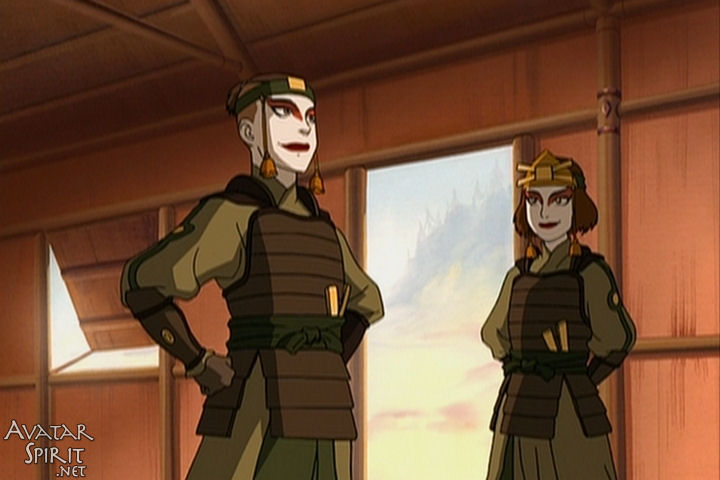
One of my favorite episodes is The Warriors of Kyoshi, which takes place early in the first season. In this episode, Sokka does some serious development with regards to his treatment of women. A character named Suki is introduced; she is the leader of the Kyoshi Warriors, a group of female fighters. It opens with Katara, Sokka and Aang getting captured by the Kyoshi Warriors, but once the people of Kyoshi Island find out that Aang is the Avatar they release them and treat them as honored guests. However, Sokka has a hard time gracefully accepting the fact that a group of girls were able to, in Katara's words, "kick [his] butt". He tries puff himself up by belittling the warriors: calling their combat class a "dance class" and saying, "... normally I'd hold a grudge, but seeing as you guys are a bunch of girls, I'll make an exception." This leads to a sparring match between him and Suki, which she easily dominates. Then Sokka has an amazing breakthrough; he goes to the warriors, asks for forgiveness and begs them to teach him how to fight. Suki then agrees to teach him under the condition that he follow all their traditions, including wearing their uniform, which happens to be a dress and makeup. Once Sokka is dressed in drag there are moments of comedy, when the kids watching are allowed to laugh at Sokka wearing a dress, but the overall message is clear: There is nothing shameful or weak in acting like a girl.  


Throughout the entire series gender equality remains a constant theme, and by creating a exciting and fun story to package these messages, the show succeeded in appealing to both boys and girls (and, as it happens, some adults). I am so thankful that there is a show out there featuring boys who have relationships with girls that extend beyond the superficial attraction we usually see. Avatar portrays girls as full characters that are friends, teachers and even, on occasion, competition. I know that this one show cannot combat all the other sources of gender stereotyping, but oh wouldn't it be great if it could? This is another instance when I could create an entire blog just to talk about one franchise. So I will just say, if you haven't watched the show, give it a shot. Show your children. 

Tuesday, September 4, 2012

Let's get this over with...


I decided to make my first post about this series because without it this blog wouldn't exist. It's what took me from, "Gee, sometimes movies are sexist and that makes me mad." to "Oh my god! Something is wrong in our culture and I'm so upset about it that I've gotta write about it and post it on the Internet!"

Basically, this feminist hates Twilight. I know, you're shocked.

Frankly, I think the whole series is a collection of sexist stereotypes that are being marketed to teenage girls as romance. I have had some debates with friends who have argued that all the points I find objectionable can be justified by the fantastical nature of the stories. But the fact that it's a fantasy series with vampires and werewolves serves as a flimsy excuse for the unhealthy behaviors exhibited by the characters. The parallels between Bella's "romances" and  abuse in the real world are shocking. 

In order to get my thoughts about the series done in one post I am picking one element to write about from each part of the series (otherwise I'd have to create a new blog just to whine about Twilight).

Twilight

The first part of the series is a pretty typical vampire love story. Girl meets Vampire, Vampire tells Girl that he really wants to kill her but won't because he's also really in love with her, Girl decides she's really in love with him too and, despite his history as a murderer, chooses to trust him anyway. While talking about the first part of the series, I'm going to focus on the main vampire in the story, Edward.

Edward is abusive. This statement has nothing to do with his being a vampire. This may seem a little odd for those who haven't read the books or seen the movie, because a lot of feminists find the very idea of vampires disturbing; considering that they are characters that embody romance, sexuality and violence all in one. A love interest that is constantly fighting the urge to kill you... definitely problematic. 

But leaving Edward's unholy appetite for human blood aside, my feminist alarm started going off when I read this passage from the first book. It takes place before Bella discovers Edward's secret and before they've started dating. Their science class has just done a lab where they prick their own fingers to find out their blood type. Bella gets sick at the sight of blood and Edward insists on seeing her home: 
We were near the parking lot now. I veered left, toward my truck. Something caught my jacket yanking me back.
“Where do you think you’re going?” he asked, outraged. He was gripping a fistful of my jacket in one hand.
I was confused, “I’m going home.”
“Didn’t you hear me promise to take you safely home? Do you think I’m going to let you drive in your condition?” His voice was still indignant.
“What condition? And what about my truck?” I complained.
“I’ll have Alice drop it off after school.” He was towing me toward his car now, pulling me by my jacket. It was all I could do to keep from falling backward. He’d probably just drag me along anyway if I did.
“Let go!” I insisted. He ignored me. I staggered along sideways across the wet sidewalk until we reached the Volvo. Then he finally freed me –I stumbled against the passenger door.
“You are so pushy!” I grumbled.
“It’s open,” was all he responded. He got in the driver’s side.
“I am perfectly capable of driving myself home!” I stood by the car, fuming. It was raining harder now, and I’d never put my hood up, so my hair was dripping down my back.
He lowered the automatic window and leaned toward me across the seat. “Get in, Bella.”
I didn’t answer. I was mentally calculating my chances of reaching the truck before he could catch me. I had to admit, they weren’t good.
“I’ll just drag you back,” he threatened, guessing my plan.
I tried to maintain what dignity I could as I got into his car.
And this is supposed to be a budding romance?! To me, this seems like a jerk talking to a teenage girl like she's an unruly three-year-old and dragging her across a parking lot. Now, call me crazy, but if this really were an attempt to help Bella by driving her home when she is unwell, rather than an attempt to assert dominance, couldn't he have just asked to drive her home?

I wish this were a rare and extreme example of Edward's misogynistic behavior, but you could open to almost any page and see something similar or worse. Throughout the film, his tone is always domineering and often threatening. In the beginning of their relationship, Edward follows Bella and sneaks into her room at night (in other words, he stalks her). Some fans might miss some of these disturbing actions because Stephanie Meyer uses the common technique of dismissing this behavior by distracting the audience with a more obvious threat. For example, when it's revealed that Edward has followed Bella, it's because he steps in to save her from a gang harassing her. This creates a perception of Edward as the good guy and excuses his controlling behavior.

Last time I checked, becoming a vampire didn't come with the uncontrollable urge to watch teenage girls while they sleep. So while it's true that vampires don't exist in the real world and chances are the young girls reading Twilight will never have to worry about a guy sucking all the blood out of their body, what does exist in the real world are really pretty guys that will treat girls like crap.

I'd like to leave Twilight with a video of "Buffy vs. Edward." And I highly recommend checking out the creator's post on WIMN, about why he decided to make the video. 


 New Moon

Twilight ends with things going well for the young lovers, but in New Moon Edward decides to get Bella away from the danger of dating a vampire by dumping her and leaving town. So in part two I am going to discuss the 100% human, Bella.

She's possibly the worst female protagonist I've ever seen.


It's a pretty common character trait for women in pop culture to have low self-esteem, but with Bella, self-deprecation drips off of every page. What little confidence she has is entirely dependent on her boyfriend. Again, common in female characters, but harmful because it socializes women that if they are unwanted by a man they are worthless. In New Moon, Bella shows us just how damaging this mindset can be when Edward disappears and she literally doesn't move for three months because she's so depressed. (Think I'm exaggerating? See the movie.) And what do you think finally pulls her out of her crippling depression? You guessed it. A boy! 

Well, a boy and becoming an adrenaline junky. One night her father convinces her to go to a movie with her friend, Jessica. On their way home Bella notices a group of scary bikers. The fear that she feels while walking toward them cause her to have a hallucination of Edward warning her to stay away. She thinks, "That's awesome!" ditches her friend, and jumps on the back of some strange guy's motorcycle. She then goes on to do a lot of other really dangerous stuff all in the hopes of her ex-boyfriend appearing and bossing her around. The only justification given is her voice over, "Maybe I'm crazy now and I guess that's okay. If a rush of danger is what it takes to see him then that's what I'll find." It's on this quest for danger that she develops a relationship with Jacob; a teenage boy who we soon discover is a werewolf. It's only after she latches onto another male that she becomes "almost healed." Jacob and his pack open up a hole other can of worms in terms of abuse and misogyny, but I promised I'd only talk about one thing that makes me mad for each book so let's just stick with Bella.

It frustrates me that such a popular female character that is written by a woman and being seen by so many young girls, is such an extreme embodiment of the stereotype that a woman is nothing without a man. She is so lost at the points in the story when she doesn't have Edward or Jacob to rely on that she finds literally no meaning in her life.

Before I finish with New Moon I would like to post an opposing view point arguing that Bella is a feminist character. It comes from Mendelson's Memos and a post titled Question of the Day: Why Isn't Bella Swan a Feminist Creation? As stated in my first post, I want to start discussions in the midst of expressing my own opinions. What do you think about my take on Bella verses the take of Scott Mendelson?
Eclipse 

In Eclipse Bella's love life gets a little more complicated. Edward and Bella get back together before the end of New Moon, Edward proposes but Bella refuses to answer due to her distaste for marriage. Jacob is pissed that she took him back and she's caught between two dudes desperately trying to mark their territory. For part three, I am going to show the lack of respect that both Edward and Jacob give to Bella with regards to her sexual agency.

Since I haven’t said much about the character of Jacob much yet, I’d like to share her reaction to Jacob’s first attempt to kiss her. Despite Bella’s protests he forces a kiss, or what I would call assault. Here is her reaction from the book (but I must preface this with a POSSIBLE TRIGGER WARNING):

            I grabbed at his face, trying to push it away, failing again. He seemed to notice this time though, and it aggravated him. His lips forced mine open, and I could feel his hot breath in my mouth.
            Acting on instinct, I let my hands drop to my side, and shut down. I opened my eyes and didn’t fight, didn’t feel… just waited for him to stop.

She then demonstrates a small amount of fight, punching him in the face. (Unfortunately, all this does is break her hand.) I was relieved that Bella’s reaction was anger, and I thought his actions were going to be dealt with for what they were, assault. However, she forgives him after a couple chapters and confesses her love for him by the end of the book, resulting in a passionate kiss. And to add insult to injury here is Edward’s response to Jacob when he hears about the kiss and Bella's broken hand:

            “…if you ever bring her back damaged again –and I don’t care whose fault it is; I don’t care if she merely trips, or if a meteor falls out of the sky and hits her in the head –if you return her to me in less than the perfect condition that I left her in, you will be running with three legs.”

Now this might be a nice sentiment (or, at least , an understandable one) if he could say it without making her sound like a used car, rather than a person who is standing right there

-->
But neither of the men in her life are in the habit of treating her like a person capable of making her own decisions. Which brings me to the topic of Edward and Bella’s sex life… or lack thereof.

Throughout the series Bella establishes that she is ready and willing to get it on but Edward keeps putting on the breaks. At first, he claims that he might lose control and hurt her with his vampire strength in the heat of the moment, then it turns into his desire to “protect her virtue”. He wants to protect her soul from the sin of premarital sex and so he refuses to even consider sex before marriage (despite the fact that Bella hates the idea of getting married). As refreshing as it could be for a female protagonist to be honest and outspoken about her desire for sex, it is made pointless because she is with a guy who doesn’t allow her to explore that, and not because he is not interested in sex but because he wants control.

Breaking Dawn- Pt. One

I’m going to make this part short, because Breaking Dawn is just a repeat of all the problems I’ve already whined about only taken to an even more absurd degree. (Also, I figure I will have to write another post when Part Two is released in theaters.) I think this NPR review of the latest movie sums it up perfectly when they say, “…when a saga popular with pre-adolescent girls peaks romantically on a night that leaves the heroine to wake up covered with bruises in the shape of her husband's hands — and when that heroine then spends the morning explaining to her husband that she's incredibly happy even though he injured her, and that it's not his fault because she understands he couldn't help it in light of the depth of his passion — that's profoundly irresponsible.”

Basically, I’m trying to say that no matter how you slice it and no matter what fantastical circumstances get set up, the stuff that happens in The Twilight Saga is MESSED. UP.

Friday, June 29, 2012

Greetings, People of the Internet!


Urban dictionary defines pontification as “posturing… speaking to people that don’t care what you say one way or another,” and “a speech or written communication that is generally pointless except to cast a favorable light on the speaker or author, as if the message were a pronouncement from on high,” ending with “usually full of shit.”

Seriously, is there a better way to describe a blog?

My name is Kira Pontiff (hence the title) and I, like so many others, have decided to start writing a blog! So here’s my obligatory “Who am I? Why am I writing this?” post:

I want to share my thoughts on gender issues in pop culture, simply because I have a lot to say. I graduated from college a year ago and majored in theater. The main thing I learned with my degree was how to analyze things to death. Since graduation I have found myself working two retail jobs and (as anyone who’s worked retail can tell you) these jobs leave you with a lot of time to let your mind wander. Being the movie lover and self-proclaimed nerd I am, I tend think about pop culture A LOT.

During these hours spent musing about the last movie I saw, I often get mad about the gender roles I see in the media. I was raised in a liberal home surrounded by socially conscious family and friends. From a young age I began identifying discrimination and attempting to do my part in fighting it. But as passionate as I have always been about social justice I sometimes feel that I talk the talk but don’t walk the walk. In other words, I spend a lot of time watching/discussing TV Shows and movies and less time actually making a difference in the world. However, I like to think that the time I spend on the latest pop culture craze is not completely pointless because these movies, songs and shows shape the world we live in whether we like it or not. Not to say that if you are a fan of a sexist piece of media that you are automatically sexist, but I often worry that if we fail to identify inequalities in the things we watch and listen to we run the risk of failing to see it in the real world.

What I want to do with this blog is name the inequalities I see in pop culture, have discussions with you about how this effects the world outside the movies and maybe find out how we can change these problems. Hopefully these pontifications of mine can serve as some baby steps in walking the walk.