To kick off the new year I am going to write out a rant that's been in my head for a few years. Taking a brief break from discussing sexism, I'm going to talk about racism; specifically, the racist casting decisions of the live action adaptation of my favorite TV Show, Avatar: The Last Airbender. It's been two years since the film was released (and, unfortunately, there are more recent examples of racist casting) but I still hold a lot of anger that a show that was such a wonderful source of diversity became such a blatant example of Hollywood Whitewashing.
It is no secret that the majority of the faces in Hollywood are white. Sure, there are a couple faces of color that have made it to the top, but they are few and far between. Some act as though this is coincidence, that everyone is given their fair chance but all the best actors just happen to be white. It disturbs me that so many believe this lie when, not only are the majority of films being produced the stories of white people, but the roles that are intended for people of color are going to white actors. Sadly, M. Night Shyamalan's The Last Airbender proved a disgusting example of the latter. The show takes place in a fantasy world that is modeled after various parts of Asia and Inuit tribes in the Artic, animated in a style that was created in Japan and, I'm just going to say it, all the characters in the show are clearly not white; yet when the film was cast the three main characters ended up being white. Shortly after this information came to light controversy began brewing, Shyamalan defended the choices in an interview that only increased my anger. Since I will probably never get a chance to sit down with him and argue about his casting choices I'm going to do the next best thing... pick his statements apart on my blog.

The story of The Last Airbender involves a war started by the Fire Nation against the three other nations in this world. Particularly in the first season of the show (which is the only season the film covers) the people of the Fire Nation are painted as the bad guys, which became a problem when M. Night Shyamalan decided to cast actors with darker skin as characters from the Fire Nation. Now, to be fair, the "good guys vs. bad guys" dynamic does get muddied throughout the series, some characters from the Fire Nation develop and join the heroes, specifically the characters Iroh and Prince Zuko. That was the first point that Shyamalan brought up in his defense: "The whole point of the movie is that there isn't any bad or good.
The irony is that I'm playing on the exact prejudices that the people
who are claiming I'm racist are doing. They immediately assume that
everyone with dark skin is a villain. That was an incredibly racist
assumption which as it turns out is completely incorrect." However, even if I pretended not to know that the original casting of Prince Zuko was the blond haired/pale skinned Jesse McCartney, who stepped down to be replaced by the Indian Dev Patel, the casting still played into the expectations of a racist society by casting people of color as the villains. Having a couple characters of color that eventually turn against their people and join the "right" side is just a slightly sneakier way of reinforcing our societies prejudices.
After claiming that he intentionally cast non-white actors as the Fire Nation to undermine our racist assumptions, he says that he cast the primary actors in a "color-blind" way. (Note: the casting call was released and it asked for Caucasian actors to fill the roles of the main characters.) He made each nation have a different ethnic background and he justified casting white actors as the originally Inuit Sokka and Katara by saying, "If you don't have an edict of 'don't put white people in the movie'
then the Water tribe can be European/Caucasian. So that's how it ended
up." It is true that over the course of the film you do see several faces that are not white, however every heroic character that is given more than two seconds of screen time is white. He's claiming that it is merely coincidence that all three of our leads ended up being Caucasian?! I call bullshit. Don't believe me? Watch the first few minutes of the film, every person in the Southern Water Tribe is Inuit except the three characters that speak. I also question the decision of dyeing the hair and tanning the skin of Nicola Peltz and Jackson Rathbone to make them look more Inuit, if they were intended to appear European/Caucasian. Putting people of color in the background and putting white people in the leads is a failed attempt to placate the people like me, while keeping the unbalanced and unfair status quo.

Finally, he claims that the animation style is at fault because,"The Anime artists intentionally put ambiguous features on the
characters so that you see who you want to see in it." So, despite the fact that the animation style was created in Japan and the entire world created in Avatar was based on Asian or Inuit cultures, Shyamalan still says that the characters are not necessarily non-white?! This is the statement that makes me the most angry. He is right that there is ambiguity in the Anime style that allows for universal relate-ability; I feel that this was all the more reason for him to cast people of color in the lead roles. That ambiguity is something that racists cling to while watching animated television shows or reading books; it is an attempt at keeping white the norm. Casting Asian and Inuit actors would have been a way to get rid of that ambiguity and definitively show people of color as heroic lead characters. When 82% of leading roles go to white actors, this was a missed opportunity to give young children of color some characters to look up to and to counter racist assumptions.
Stars aren't born, they are created by film makers who continue to choose white faces and steal opportunities that belong to actors of color. There are countless epic fantasy series out there for Caucasian actors and I have no doubt that there will be plenty more in the future. When a franchise that is designed for Asian actors, like Avatar: The Last Airbender, comes along it's time we demand that those roles be filled by Asian people, rather than continue to makeup white actors who have significantly more opportunities. (Seriously, it's the least we can do.) I don't know if M. Night Shyamalan was lying to us or to himself in this interview, but at the very least he's displaying horrible ignorance to the racism in the film industry and society at large.
For more information on The Last Airbender casting and racism in other Hollywood films please visit and show your support for Racebending.com.
After my last post, where I raved against the franchise I hate the most, I wanted to follow up by praising a franchise I love. Many of you may not have heard of the show Avatar: The Last Airbender (or you might think it has something to do with blue people on the planet Pandora), but let me tell you, it's a must see. Some people look at me funny when I say that, "Isn't that a kid's show?" they ask. Yes, it's a children's show that premiered on Nickelodeon in 2005. I put off watching the show for years for that very reason. But one friend persisted and got me to sit down and watch. At first my reaction was positive but unenthusiastic, "It's good... for a kid's show." But by the middle of season two I was literally yelling at my television, rooting for "Team Avatar" and now I often site it as my favorite television show (high praise- believe me).
Now that I have watched the show several times in it's entirety, I've concluded that it's being meant for children is part of what makes it so great. In addition to being an enjoyable show it's jam-packed with great messages for kids.
The show is set in a mythical world where there are four nations: Water, Earth, Fire and Air. In each nation there are benders; people who are able to control an element and they use this power as a martial art. There is one person in the world who is able to control all four elements, called the Avatar, who acts as a spiritual mediator between the four nations. The story takes place in the midst of a war between the Fire Nation and the other nations. The Avatar has been absent for one hundred years and is found frozen in an iceberg by a brother and sister from the Southern Water Tribe (Sokka and Katara). Aang (the Avatar) is a young boy who was born an airbender and has yet to master the other three elements. The story follows the three children as they travel the world, gaining the skills necessary for them to defeat the Fire Lord and end the war.
It's a very well-crafted hero quest that is compelling to watch the whole way through. There are a million reasons why I love the show: the artistry involved in creating the mythological world, the excitement and careful thought put into every action sequence, the humor that perfectly caters to both children and adults, and the believable and loveable characters.
But enough about why I think the show is good, why I am writing about it on this blog? This is a feminist show if ever I saw one and the best part is -- this show is targeted at
boys!
The more I examine film and television for gender biases, the more I notice shows directed towards women and girls are headed in a good direction. More and more shows targeted at women feature strong women with dynamic personalities and goals beyond landing a boyfriend. But shows that are targeted to men and boys... not so much. Women in these shows are rarely portrayed as anything other than plot devices at the best of times. So when I saw a show for boys that not only features strong females as more than the object of a male's desire, but addresses sexism head on, you can bet I was over the freaking moon!
In the very first episode the subject of sexism is addressed almost as soon as we meet Sokka and Katara. The pair are out on a fishing trip and Sokka makes a comment, "I knew I should have left you at home. Leave it to a
girl to screw things up." A lot of shows would let a comment like this slide but Katara wastes no time in calling him out, "You are the most sexist, immature, nut-brained -- ugh! I'm embarrassed to be related to you!" It's a brief moment that takes a comment children might hear on a playground and lets them know, those comments are not cool.
One of my favorite episodes is
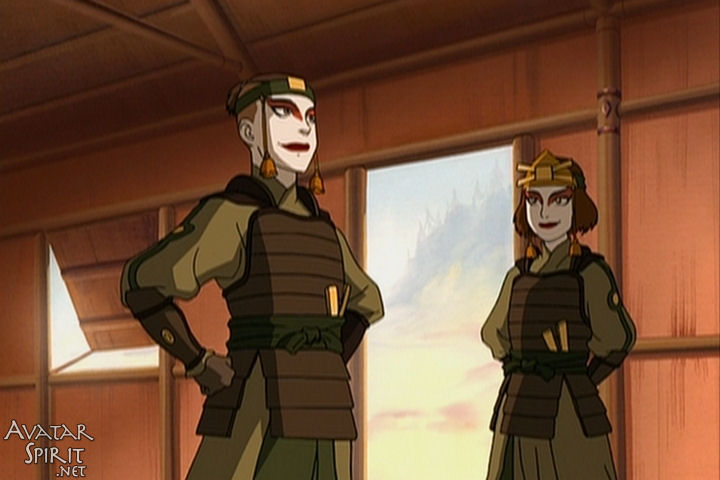
The Warriors of Kyoshi, which takes place early in the first season. In this episode, Sokka does some serious development with regards to his treatment of women. A character named Suki is introduced; she is the leader of the Kyoshi Warriors, a group of female fighters. It opens with Katara, Sokka and Aang getting captured by the Kyoshi Warriors, but once the people of Kyoshi Island find out that Aang is the Avatar they release them and treat them as honored guests. However, Sokka has a hard time gracefully accepting the fact that a group of girls were able to, in Katara's words, "kick [his] butt". He tries puff himself up by belittling the warriors: calling their combat class a "dance class" and saying, "... normally I'd hold a grudge, but seeing as you guys are a bunch of girls, I'll make an exception." This leads to a sparring match between him and Suki, which she easily dominates. Then Sokka has an amazing breakthrough; he goes to the warriors, asks for forgiveness and begs them to teach him how to fight. Suki then agrees to teach him under the condition that he follow all their traditions, including wearing their uniform, which happens to be a dress and makeup. Once Sokka is dressed in drag there are moments of comedy, when the kids watching are allowed to laugh at Sokka wearing a dress, but the overall message is clear: There is nothing shameful or weak in acting like a girl.

Throughout the entire series gender equality remains a constant theme, and by creating a exciting and fun story to package these messages, the show succeeded in appealing to both boys and girls (and, as it happens, some adults). I am so thankful that there is a show out there featuring boys who have relationships with girls that extend beyond the superficial attraction we usually see.
Avatar portrays girls as full characters that are friends, teachers and even, on occasion, competition. I know that this one show cannot combat all the other sources of gender stereotyping, but oh wouldn't it be great if it could? This is another instance when I could create an entire blog just to talk about one franchise. So I will just say, if you haven't watched the show, give it a shot. Show your children.